
Acid Wash T-Shirt Manufacturer: MOQ, Fabric & Wash Guide for Brands
An acid wash t-shirt manufacturer takes a finished cotton tee and tumbles it with stones, enzymes or mineral agents to strip colour unevenly, producing the marbled, vintage look that streetwear brands ask for. At Sleek Apparels we make acid wash tees from 50 pieces per style, all year, and the wash is approved on a physical sample before bulk production begins.

By Raj Rahman, Founder & Managing Director

What is an acid wash t-shirt?
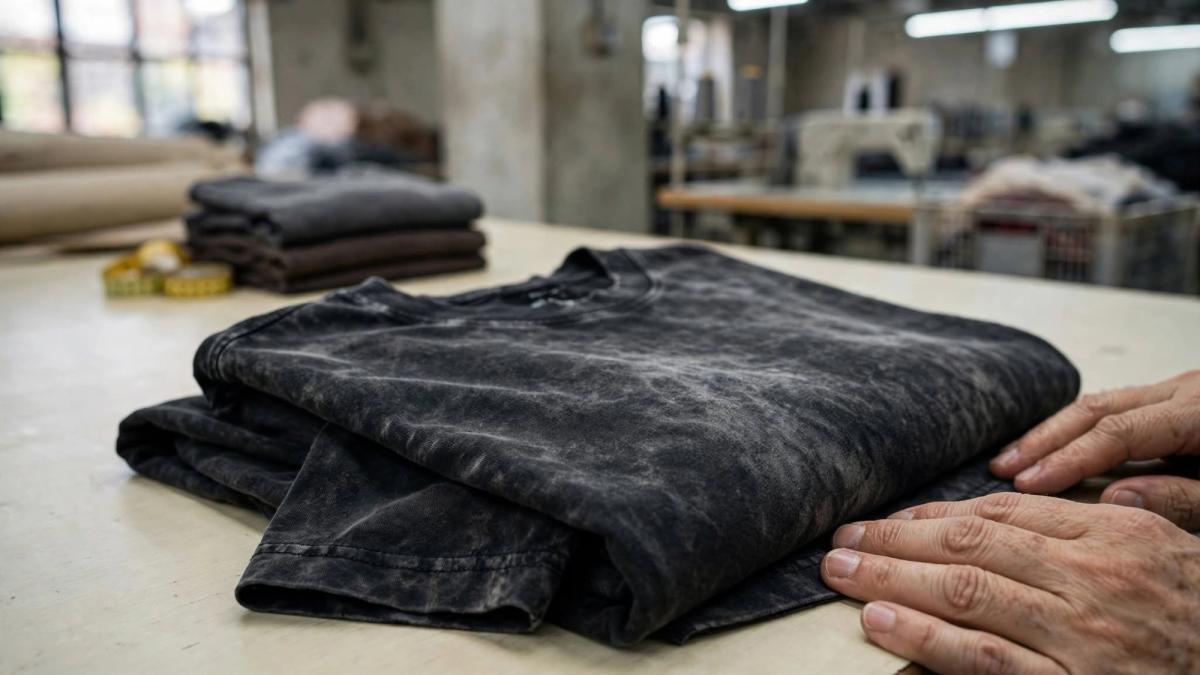
An acid wash t-shirt is a garment whose colour has been removed unevenly after sewing, leaving light, cloudy patches against a darker base. The result is a worn-in, marbled finish that sits at the centre of heavyweight and oversized streetwear.
The name comes from the original method. Pumice stones were soaked in a bleaching agent and tumbled with dry garments, so the colour faded only where the stones touched the fabric. Today the same look is made in several ways, and the method matters for cost, consistency and what you can honestly tell your customers.
How are acid wash t-shirts made in a factory?
Every acid wash tee starts as a normal garment: fabric is cut, sewn and finished first, and the wash is applied last. Washing the finished garment, not the fabric roll, is what creates the uneven, one-of-a-kind look, and it is also why the wash changes the final size of the tee.
Acid wash vs mineral, enzyme and stone washes
Classic acid wash uses an oxidising agent to strip dye. Many modern streetwear programmes use gentler mineral, enzyme and stone processes instead, which give a similar faded look with a softer hand and a wider safety margin. Academic work on denim confirms how strongly the choice of chemistry and concentration drives results: a 2020 study found that stronger acid concentrations increased shrinkage and changed fabric weight [1]. Knit tees behave differently from denim, but the principle holds: more aggressive means less predictable.
| Method | Look | Consistency | Hand-feel | Best for |
|---|---|---|---|---|
| Classic acid wash (oxidising agent + stones) | Sharp, high-contrast marbling | Lowest: very uneven | Can be harsher | Strong retro/90s looks |
| Mineral / stone wash | Cloudy, softer marbling | Moderate | Softer | Most streetwear acid wash tees |
| Enzyme wash | Light, even fade | Highest of the washes | Very soft | Subtle vintage, lived-in feel |
| Garment dye (no fade) | Tonal, uniform colour | High, slight seam variation | Soft | Solid colours, not marbled |
Our own acid wash programme is built on enzyme, stone and mineral processes rather than potassium permanganate. That is a process description, not a certification, and we recommend you agree the exact wash method in writing with any manufacturer you use.
Which fabric and GSM work best for acid wash t-shirts?
100% cotton jersey is the safest base. Cotton takes the wash evenly, softens nicely and shows the contrast you are paying for. Polyester and high-poly blends resist this kind of fading, so a CVC or poly-cotton tee will look flatter and less marbled.
Weight matters as much as fibre. A 240 GSM oversized tee gives a drapey, lived-in look, while a ~300 GSM heavyweight tee holds its shape better through the wash and feels more premium. Lighter fabric can look thin and twist after washing. If you are still deciding on weight, our GSM guide explains how each band behaves GSM Explained: Choosing the Right Fabric Weight [https://www.sleekapparels.com/blog/gsm-fabric-weight-guide/], and our heavyweight sourcing guide covers the 240-320 GSM range in detail How to Choose a Heavyweight T-Shirt Manufacturer [https://www.sleekapparels.com/blog/how-to-choose-a-heavyweight-t-shirt-manufacturer-240-320-gsm-guide/].
Color choice drives the visual result. Dark bases such as black, charcoal, navy and brown show the strongest contrast. Pale colours fade to very little, so we usually steer brands who want visible marbling towards darker shades.
Acid wash t-shirt manufacturer MOQ, sampling and lead times
Our MOQ is 50 pieces per style, all year, with no seasonal increase. Colours can usually be split within a single design, so a 50-piece run does not have to mean 50 identical units. There is no minimum per size, so you can split a run freely across S, M, L and XL.
Sampling matters more for washed garments than for plain ones, because the wash cannot be judged from a drawing. The sample development charge is USD 60 per style, credited against your bulk order. The buyer also pays the garment cost and the courier. We only quote bulk pricing once we have your tech pack, since the wash depth, GSM and decoration all move the price. Washed goods are quoted per style.
| Stage | What happens | Typical time |
|---|---|---|
| Tech pack and wash brief | You send the tech pack, reference photo and target quantity | Before quote |
| Sample development | Pattern, blank sewing and wash development; USD 60 per style, credited against bulk | 10-12 days |
| Sample approval | You approve fit, wash look and variation range on the physical sample | Your side |
| Deposit | 50% before production starts | On approval |
| Bulk production (up to 2,000 pcs) | Cutting, sewing, finishing, QC and packaging in-house; wash adds a few days | 12-15 days, varies by season |
| Balance and shipping | 50% before shipment; door-to-door delivery with freight included | Per route |
Wash time depends on your design and the time of year, so treat the figures above as a planning guide and confirm dates when you place the order. For more on planning backwards from your launch date, see Apparel Manufacturing Lead Times Explained [https://www.sleekapparels.com/blog/apparel-manufacturing-lead-times/].
Why shrinkage and consistency decide whether an acid wash tee works
Every wet process shrinks cotton, and washing after sewing shrinks the whole garment, mainly in body length and sleeve length. The most common mistake we see on washed-garment briefs is a size chart written for the unwashed tee. The fix is simple: ask your factory to cut the pattern allowing for wash shrinkage and write your target measurements as finished-after-wash dimensions.
Standard tests make this measurable. AATCC TM135 measures length and width change after home laundering [2], and ISO 105-C06 tests how well colour holds up to domestic and commercial laundering [3]. Ask what a supplier tests, what the results were on a similar garment, and whether the sample you are holding went through the same wash as the bulk will.
Be realistic about variation, too. An acid wash is by nature uneven, so no two tees will match exactly. What you control is the range. Agree an approved master sample, an intensity standard and an acceptable variation range before bulk starts, and keep the approved sample on file for reorders. Without this, a repeat order can look noticeably different from the first.
How to brief a factory: acid wash t-shirt tech pack checklist
A clear brief saves a sampling round. Beyond the usual measurements, a washed tee needs a few extra lines in the tech pack. If you have not built one before, start with How to Create a Tech Pack [https://www.sleekapparels.com/blog/how-to-create-a-tech-pack/] and add the items below.
| Tech pack item | What to write |
|---|---|
| Base fabric and GSM | Fibre content, GSM and colour before wash (e.g. 100% cotton jersey, black) |
| Wash type and look | Reference photo, wash method (stone, mineral, enzyme) and desired intensity |
| Finished-after-wash sizes | Measurements you want after washing, not before |
| Variation range | How far tees may differ from the approved master sample |
| Print / embroidery | Artwork, size, placement and method; confirm whether applied after wash |
| Labels and packing | Neck label, care label wording, folding and polybag requirements |
| Care instruction | Cold wash, inside out, no tumble dry, to protect the finish |
Can you print or embroider on acid wash t-shirts?
Yes. We screen print and DTF print in-house, and embroidery is done through a partner factory. Print and embroidery each carry their own development cost on top of a blank sample, and branding adds a per-piece cost in bulk, so ask for these to be quoted separately.
Print placement on a marbled base needs thought. A solid chest logo will sit over patches of different brightness, which can look intentional or messy depending on the artwork. We approve print placement and wash together on the sample so there are no surprises in bulk.
What to ask an acid wash t-shirt manufacturer before paying a deposit
- Can I see and handle a physical wash sample made on the same fabric and colour as my order?
- Is the wash method enzyme, stone, mineral or chemical bleach, and is that written into the order?
- How are shrinkage and finished-after-wash measurements handled in the pattern?
- What variation range is acceptable, and who signs off the master sample?
- Which certifications do you actually hold, and can you provide the documents? We hold BSCI; ask every supplier for proof of whatever they claim.
- What are the payment terms? Ours are 50% before production and 50% before shipment.
- Who handles shipping and duties? We deliver door to door with freight included in the unit price, and the buyer pays import VAT and duties at customs. DDP is also possible through a freight forwarder, quoted separately.
For a wider look at what separates a reliable factory from a risky one, read How to Verify a Bangladeshi Garment Factory [https://www.sleekapparels.com/blog/how-to-verify-a-bangladeshi-garment-factory/].
Request a quote for acid wash t-shirts
If you are planning an acid wash tee or a wider washed range, send us your tech pack or even a reference photo and your target quantity. We will come back with a sampling plan and a per-style quote. Visit our acid wash collection [https://www.sleekapparels.com/collections/acid-wash/] to see what we make, then request a quote [https://www.sleekapparels.com/quote/] or email inquiry@sleekapparels.com. You can also message us on WhatsApp at +880 1861-011367.
Frequently asked questions
- What is the minimum order for acid wash t-shirts?
- Our MOQ is 50 pieces per style, all year, with no seasonal increase. Colours can usually be split within a single design, and there is no minimum per size, so you can split a run freely across S to XL. Send your tech pack and we will confirm the exact minimum when quoting.
- How long does it take to make acid wash t-shirts?
- Sample development takes 10-12 days. Bulk production for up to 2,000 pieces generally takes 12-15 days, and the wash adds a few more days depending on design and season. Plan your launch date backwards from approval of the physical sample, and confirm dates when you place the order.
- Which fabric is best for acid wash t-shirts?
- 100% cotton jersey is the best base because it takes the wash evenly and shows strong contrast, especially in dark colours such as black or charcoal. Heavier tees of around 240 to 300 GSM hold their shape better. Polyester and high-poly blends fade much less and look flatter.
- Will every acid wash t-shirt look exactly the same?
- No. Acid wash is uneven by nature, so each tee has its own pattern. What you can control is the range: agree an approved master sample, an intensity standard and an acceptable variation before bulk starts. Keep that sample on file so reorders match your first batch as closely as possible.
- How much does it cost to manufacture acid wash t-shirts?
- Price depends on GSM, wash depth, colour, quantity and any print or embroidery, and the wash is often a bigger cost driver than the blank tee. We quote per style once we have your tech pack. Contact us for current pricing, and note that the USD 60 sample charge is credited against bulk.
More from the blog
How to Choose a Heavyweight T-Shirt Manufacturer (240–320 GSM Guide)
A buyer's checklist for choosing a heavyweight t-shirt manufacturer: what 240–320 GSM really means, which specs to lock in, and realistic MOQs and lead times.
Read article →MarketsUS Tariffs on Bangladesh Apparel in 2026: What Buyers Actually Pay
What the 2026 tariff changes actually cost per unit, how Bangladesh compares to Vietnam and China right now, and how to model it before you order.
Read article →FabricsWoven vs Knitted Fabrics: The Complete Guide
Warp and weft against loops: the two ways cloth is made, why one holds its shape and the other stretches, and how that single difference decides your fabric, your pattern and your price.
Read article →There are 63 guides in total — browse the full manufacturing and sourcing library.